
Georgia Tech's H. Milton Stewart School of Industrial and Systems Engineering (ISyE) is launching a new Minor in Health Systems this fall. The 15-credit-hour minor is listed in the 2026-2027 catalog and is open to undergraduates in every major.
The minor is designed to equip students to address complex challenges across healthcare delivery, public health, and health-related decision-making. Through coursework in analytics, optimization, policy, and systems engineering, students will learn how to improve access to care, strengthen healthcare operations, and make better use of limited resources.
A hospital decides how many operating rooms to staff on a specific day. A vaccine that works in a trial fails to reach the population that needs it. A single manufacturer’s plant shuts down due to a hurricane and a routine medical supply becomes unavailable nationwide. A public health agency has to decide whether limited resources will have greater impact through a screening program or a housing intervention.
These are the types of real-world challenges students in the Health Systems minor will learn to address. They are not purely medical questions. They are systems questions, and they are the kinds of challenges industrial and systems engineers are equipped to solve.
"Many of today’s health challenges are fundamentally systems challenges,” said Pinar Keskinocak, the H. Milton and Carolyn J. Stewart School Chair and professor in ISyE. “Improving health requires not only advances in medicine, but also better systems for prevention, access, care delivery, and decision-making."
The minor was developed by Professors Turgay Ayer, ISyE’s Virginia C. and Joseph C. Mello Chair and professor, and Nicoleta Serban, an ISyE professor, working with faculty across ISyE's health systems area.
“Health systems problems are complex because decisions made in one part of the system often have consequences elsewhere,” said Ayer. “We developed this minor to give students a systems-level understanding of healthcare systems, while equipping them with practical analytical and decision-making tools. Our goal is for students to leave the program prepared to translate data into better decisions and, ultimately, better health outcomes.”
“This minor grew out of years of health systems research and teaching across ISyE,” added Serban. “Through my work in health analytics, Medicaid policy, healthcare access, and health system complexity, and through teaching Public Health Systems, I saw both the breadth of faculty expertise in this area and strong student interest in engaging with it. The minor brings those strengths together in one pathway that enables students from across Georgia Tech to understand health systems and develop the analytical tools to improve them.”
What students take
The minor is 15 credit hours: a statistics foundation, two required health systems courses, and at least two electives.
Students begin with a statistics course, choosing from seven options across campus: ISYE 3770, ISYE 3030, BME 2400, ECE 3077, ECON 2250, MGT 2250, or PUBP 3120. This flexibility allows students from a variety of academic disciplines to enter the health systems core with a shared quantitative foundation.
Two ISyE courses form the core. Public Health Systems (ISYE 4510), designed by Serban and Keskinocak, works at the population scale. Many health challenges are shaped long before patients enter a hospital. The course examines factors that influence access to care, prevention, and population health, and explores how engineering and data-driven approaches can improve outcomes.
Students study healthcare access: how to measure it, how geography shapes it, and what epidemiology and spatial analysis reveal about who a system reaches.
The course also spends three weeks on prevention and wellbeing across infectious and non-infectious disease. The organizing theme is what Serban calls the three E's: equity, efficiency, and effectiveness, and the trade-offs among them when resources are finite. Students leave able to identify where quantitative methods can improve public health decision-making.
Intelligent Healthcare Delivery Systems (ISYE 4515) launches alongside the minor. The course was originally designed by Ayer and is being adapted for this minor by Dima Nazzal, ISyE’s associate chair for academic administration, and Lauren Steimle, the Harold R. and Mary Anne Nash Early Career Professor and assistant professor in ISyE. The course focuses on healthcare delivery: how patients move through clinics and hospitals, where care transitions break, and how to map a process well enough to identify where to change it. Students learn to evaluate a health system's performance and model improvements through process design and resource allocation, such as bed allocation, operating room block scheduling, and nurse staffing.
“Just as doctors diagnose and treat disease when patients present with symptoms, students in this class will learn engineering tools to diagnose and solve process problems that lead to symptoms such as delays in care, shortages of medical supplies, and provider burnout,” said Steimle. “With these skills, students will be prepared to help healthcare systems deliver the right care to the right people, in the right place, at the right time.”
The remaining six credit hours come from a slate of more than 25 electives in five categories: health systems analytics and modeling; health policy, economics, and management; environmental, public health, and bio-inspired systems; health systems modeling and optimization; and machine learning and data science for health. The courses come from Biomedical Engineering, the College of Computing, the Scheller College of Business, the Ivan Allen College of Liberal Arts, the College of Design, Civil and Environmental Engineering, and Electrical and Computer Engineering, as well as ISyE. Students are encouraged to choose from more than one category.
"A student can come into this from computing, from policy, from business, from design," said Nazzal. "We built the electives so that whatever quantitative preparation a student already has counts for something, and so that nobody has to leave their major behind to work on health. Health systems problems don't get solved by one discipline, and the curriculum shouldn't pretend otherwise."
Students may also complete an optional experiential component through a health-focused Senior Design capstone, undergraduate research, a Vertically Integrated Project, or a Serve-Learn-Sustain project. Students whose primary project isn't health-related complete a structured addendum connecting the work to health systems challenges.
For most students, courses count toward both major and minor requirements. Prerequisites and full requirements are in the catalog, and students should check them against their own program before declaring.
ISyE: A leader in health systems engineering
Georgia Tech is well known for health research. Less well known is the role industrial and systems engineering has played in advancing health systems research for decades.
ISyE's health systems footprint spans different kinds of problems. In healthcare operations, faculty and students work on patient flow, scheduling, capacity, and care coordination inside hospitals and clinics. In health systems and supply chains, they study how care, drugs, vaccines, and medical equipment move across networks of providers and suppliers. In AI and analytics for health, they address medical decision-making, disease modeling, and the role of algorithms in healthcare. In public health systems, they examine access, equity, and population-level resource allocation.
That work runs through a Master of Science in Health Systems, the Center for Health and Humanitarian Systems, and Senior Design projects that have been going into Georgia’s health systems for years. Research collaborators include the Centers for Disease Control and Prevention, Children's Healthcare of Atlanta, Emory University, and the Georgia Department of Public Health among many others. Senior Design sponsors have included Emory Healthcare, Wellstar, Grady Health System, Piedmont Healthcare, and Northside Hospital. These projects are not case studies: student teams work on real challenges brought by sponsors and deliver decision-support tools and other design solutions.
More than twenty ISyE faculty work in health and humanitarian systems, spanning patient-centered decision support, clinician guidance, healthcare operations, health network design, and policy evaluation.
"ISyE has been a leader in health systems research, education, and practice for decades,” said Keskinocak. “This minor creates a clear pathway for undergraduate students from across Georgia Tech to apply analytics, AI, optimization, and systems thinking to some of society's most important challenges in healthcare and public health."
Full requirements are in the Georgia Tech Catalog and on the ISyE Health Systems minor page.

ISyE faculty leading the new Health Systems minor include (top row, left to right) Dima Nazzal, Pinar Keskinocak, and Turgay Ayer; and (bottom row, left to right) Lauren Steimle and Nicoleta Serban.
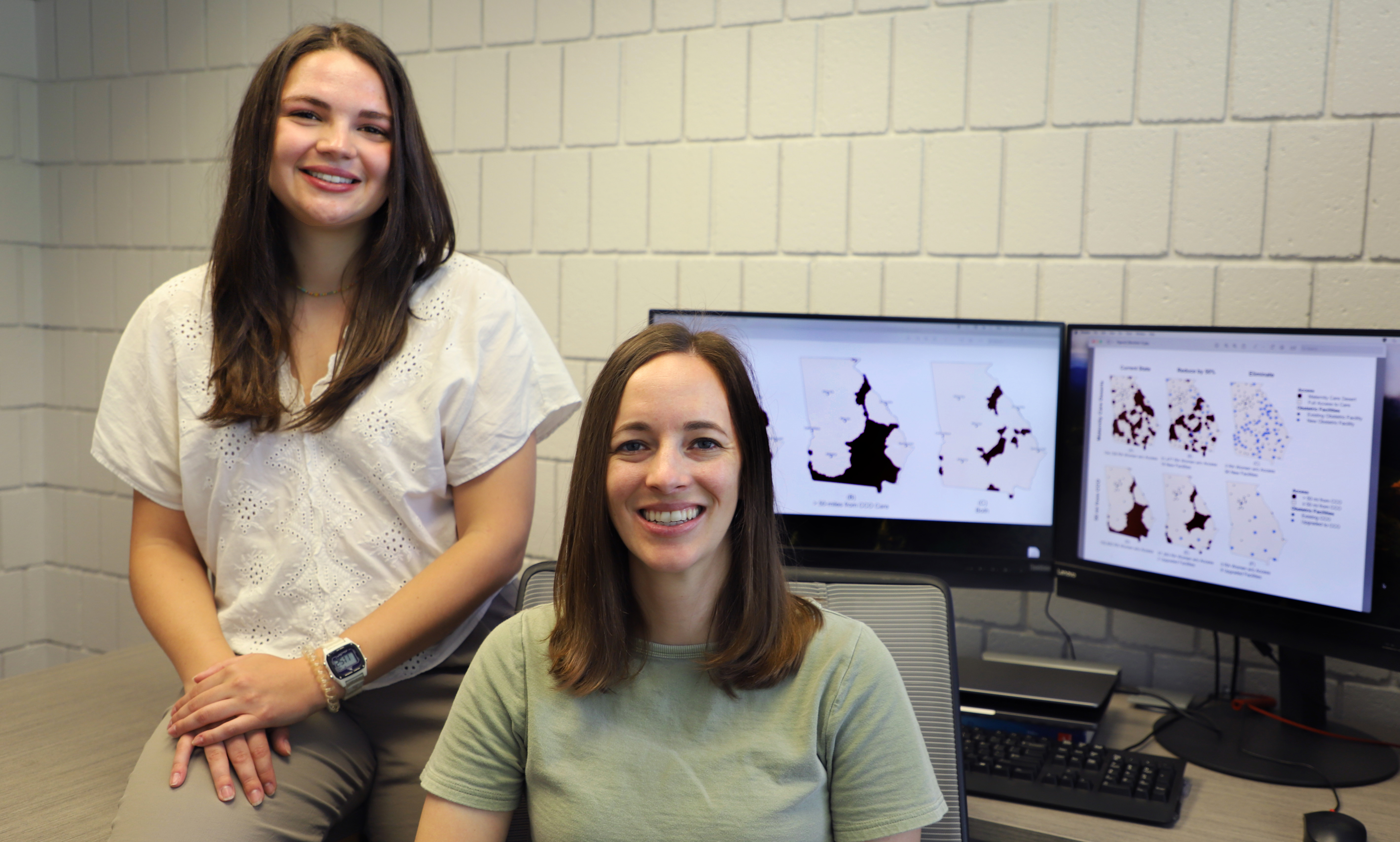
ISyE researchers are addressing critical healthcare challenges through data-driven health systems research. Lauren Steimle's work on maternal healthcare access, conducted with Meghan Meredith (ISyE Ph.D. '25), is one example.