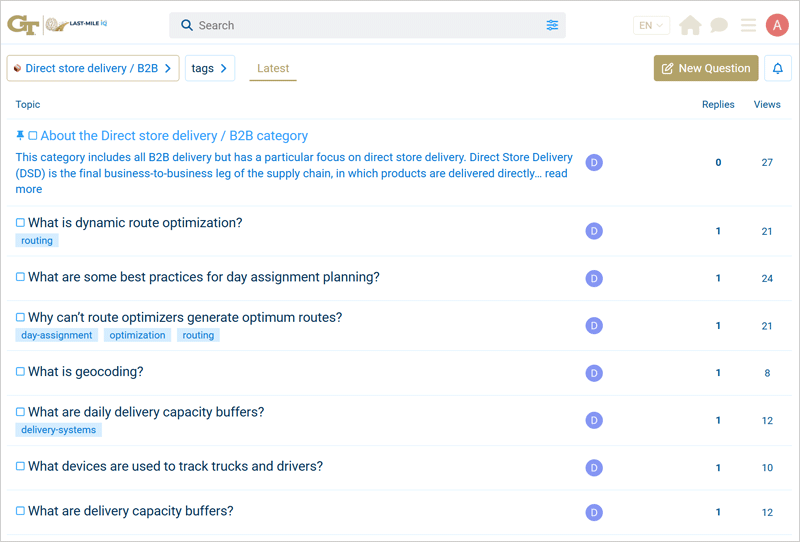
What Is LastMile-IQ?
LastMile-IQ is an open-access question-and-answer platform designed specifically for last-mile delivery professionals. The platform captures real-world operational knowledge and makes it searchable for practitioners, leaders, researchers, and technology providers.
Users can:
Ask operational questions
Explore expert responses
Search a growing archive of industry knowledge
Benchmark solutions used across organizations
Learn from peer experiences
Connect with verified experts and practitioners

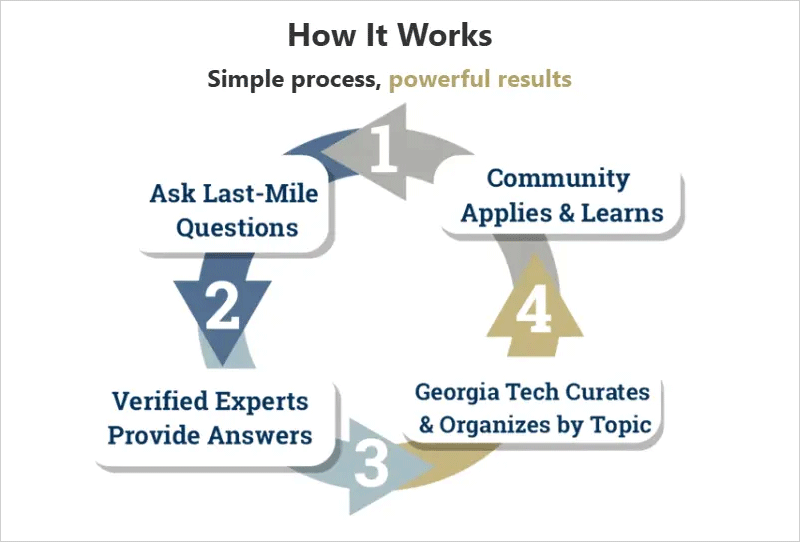
How It Works
1. Ask Last-Mile Questions
Operational teams submit questions based on real-world challenges.
Examples include:
- Which KPIs improve performance without creating gaming?
- When does dynamic routing help or hurt operations?
- How should service levels be adjusted when density changes?
- What causes failed deliveries and which fixes work best?
- How can organizations reduce cost per stop while maintaining service quality?
2. Verified Experts Provide Answers
Industry leaders and experienced practitioners contribute evidence-based responses grounded in operational experience.
3. Georgia Tech Curates Knowledge
Responses are organized and structured into a searchable knowledge repository, ensuring information remains accessible and valuable over time.
4. Community Applies & Learns
Organizations can immediately apply insights, benchmark approaches, and continuously improve last-mile operations
Project Requirements
- Engineering Design
The project must involve a recommendation for change(s) to an existing system or the development of a new system and an economic analysis of the associated costs and benefits. - Magnitude
Each team member is expected to spend a minimum of 12 productive hours per week on the project for a total of 180 hours for the semester, which equates to a minimum of 1080 hours for a six-member team. The project’s scope must be consistent with this expectation. - Value
The value of the project to the client must be commensurate with the amount of time spent. - Methodology
The project must require the use of substantial industrial and systems engineering tools and methods learned in the curriculum.
Client Responsibilities
- Identify a real need the organization is facing.
- Ensure that there is significant design content in the proposed project; that is, the scope of the project must be such that a recommendation for a change to a system is made and there is demonstrated value for implementing the change, and that it has a significant impact on the organization.
- Meet with the student team on the site at the facility to explore possibilities, and determine the scope of the project.
- Assign a responsible technical or managerial person to give the team appropriate guidance, operations and economic information, and site access if needed. During the semester, this person will need to spend approximately 2-4 hours per week interacting with team members.
- Make arrangements for an appropriate level of management to receive and consider the team's formal proposal, interim report, tentative results, conclusions, and final design.